
“Come see the world’s best and many world firsts!” is the claim on the front of the English language brochure handed out at Okinawa’s Churaumi Aquarium. Thanks for the sound bite, but we had already made the 3 hour trek from Naha (see “L”) by the time we received the pamphlets and weren’t about to get back on the stuffy bus without seeing all the aquarium had to offer. The pamphlet could have said pretty much anything and we would have gone.
The main attraction at the Okinawa Aquarium is one of the largest fish tanks in the world, which is wrapped in “the world’s best” acrylic panel (22.5 meters wide, 8.2 meters high and 60 cm thick). It was even featured on the Discovery Channel. For all of its claims to fame, it was quite impressive. Inside the tank were 2 (or was it 3?) whale sharks, the largest in captivity, dozens of smaller sharks and manta rays, all swimming around peacefully while hundreds, if not thousands of Japanese tourists (and the random gaijin like myself) snapped pictures with digital cameras and cell phones.


 Cleaning time!
In addition to the large tank, there were many smaller tanks and displays very similar to the exhibits at every other aquarium. The touch pool was so crowded with small children that it was impossible to get close enough to touch any of the poor organisms inside. One smart starfish with an uncanny resemblance to Patrick of the Spongebob fame, had lodged himself in between the rocks out of everyone’s reach.

Beni-imo soft cream
So good I ate it all 5 days; Jamie, Allison and I became regulars at the Blue Seal ice cream shop on Kokusai-dori. The purple sweet potato flavor went perfectly with vanilla; memories of the sublime combination continue to haunt me. Upon returning to my apartment, I thought the linoleum in my kitchen kind of looked like a beni-imo ba-ni-ra mikusu cone.
So good I ate it all 5 days; Jamie, Allison and I became regulars at the Blue Seal ice cream shop on Kokusai-dori. The purple sweet potato flavor went perfectly with vanilla; memories of the sublime combination continue to haunt me. Upon returning to my apartment, I thought the linoleum in my kitchen kind of looked like a beni-imo ba-ni-ra mikusu cone.
 I should know by now that pictures of me stuffing my face are bound to be unflattering.
Castle
Shuri-jo castle in Naha is an impressive labyrinth of big stone walls broken up by even larger gates. The castle itself isn’t too large, but what it lacks in size it makes up for by being painted a bright red.
Shuri-jo castle in Naha is an impressive labyrinth of big stone walls broken up by even larger gates. The castle itself isn’t too large, but what it lacks in size it makes up for by being painted a bright red.


Dragon Boats
Every year in early May, Naha hosts Dragon Boat races. I am not too up on the history of the event, but we were lucky enough to catch the last race while we were there. Three boats full of strong armed men line up and then must paddle quickly out to a flag, turn around and come back again. We watched the blue, black and yellow teams (their official names, I am sure). The blue boat started off with a bang (probably because they were the only team who could hear the pitifully quiet starter’s gun,) but were a bit too powerful, overshooting the flag and having a difficult time turning around. The black team paced themselves better, and had their turning technique down pat, which allowed them to finish first. The poor yellow team was a bit out to sea the whole time.
Every year in early May, Naha hosts Dragon Boat races. I am not too up on the history of the event, but we were lucky enough to catch the last race while we were there. Three boats full of strong armed men line up and then must paddle quickly out to a flag, turn around and come back again. We watched the blue, black and yellow teams (their official names, I am sure). The blue boat started off with a bang (probably because they were the only team who could hear the pitifully quiet starter’s gun,) but were a bit too powerful, overshooting the flag and having a difficult time turning around. The black team paced themselves better, and had their turning technique down pat, which allowed them to finish first. The poor yellow team was a bit out to sea the whole time.


Emerald Beach
A short walk from the Aquarium is Emerald Beach. The name and the pictures in the brochures had us expecting a glorious stretch of white sand and turquoise-green waters. Alas when we got there, we only found a weird shaped (most likely man-made) peninsula, covered with small children, speakers blaring one of the worst beach soundtracks ever (think uncensored Eminem and Avirl Lavigne) and a ring of blue buoys around the whole thing, severely limiting the inflow of fresh sea water. But the sun was shining, and after the 3 hour bus ride we weren’t about to pass up a beach opportunity.
A short walk from the Aquarium is Emerald Beach. The name and the pictures in the brochures had us expecting a glorious stretch of white sand and turquoise-green waters. Alas when we got there, we only found a weird shaped (most likely man-made) peninsula, covered with small children, speakers blaring one of the worst beach soundtracks ever (think uncensored Eminem and Avirl Lavigne) and a ring of blue buoys around the whole thing, severely limiting the inflow of fresh sea water. But the sun was shining, and after the 3 hour bus ride we weren’t about to pass up a beach opportunity.

Farmer’s tan
Allison is genetically blessed and tans almost instantly without burning. Jamie and I were a little more worried about the harmful effects the sun’s rays would have on our skin and took care to apply lots of sun block. The sun screen did its job…sort of. Most parts of our bodies hardly changed color at all (still pasty!) but our hands and forearms are now noticeably browner. Not really sure this is an improvement, since the disparity will just continue to worsen as it gets warmer and we ride our bikes around.
Allison is genetically blessed and tans almost instantly without burning. Jamie and I were a little more worried about the harmful effects the sun’s rays would have on our skin and took care to apply lots of sun block. The sun screen did its job…sort of. Most parts of our bodies hardly changed color at all (still pasty!) but our hands and forearms are now noticeably browner. Not really sure this is an improvement, since the disparity will just continue to worsen as it gets warmer and we ride our bikes around.
Goya Galore
One of Okinawa’s claims to fame is an odd looking fruit called a goya (or bitter melon in English.) As the English name suggests, it is incredibly bitter. I like it in small doses. One day for lunch I ordered a set that came with goya champaru, and had to leave some behind on my plate because it was a little too much. Much better than the fruit itself are all the goya-themed products it has spawned—plush toys, t-shirts, fans, public benches…
One of Okinawa’s claims to fame is an odd looking fruit called a goya (or bitter melon in English.) As the English name suggests, it is incredibly bitter. I like it in small doses. One day for lunch I ordered a set that came with goya champaru, and had to leave some behind on my plate because it was a little too much. Much better than the fruit itself are all the goya-themed products it has spawned—plush toys, t-shirts, fans, public benches…

That's Mr. Goya on the left, with his Okinawan friends Ms. Pineapple and Mr. Beni-imo.

It's hard to read, but the naked Kewpie is saying "Okinawa is too hot!" and has stepped out of her goya outfit.
 The coolest way to keep cool.
Hibiscus
What can I say? They were everywhere. And I took pictures of a lot of them as if I had never seen such a thing before (not true.) Flowers do make such great subjects though.
What can I say? They were everywhere. And I took pictures of a lot of them as if I had never seen such a thing before (not true.) Flowers do make such great subjects though.


Ick
Remember my very first blog post? The one about the snake in a bottle I found while cleaning my apartment after I moved in? Well, now I know were to get more, should I so desire. And much bigger ones too (for the bargain price of almost $700)!!
Remember my very first blog post? The one about the snake in a bottle I found while cleaning my apartment after I moved in? Well, now I know were to get more, should I so desire. And much bigger ones too (for the bargain price of almost $700)!!

Another food specialty of Okinawa is pork, and when they say pork, they really mean the whole entire pig. Face, feet and everything in between. We saw it all at the open market. Mmmm mmmm good.

Jacks
I think Japan has maybe one or two rivers that still run wild with out dams or concrete channels, and I think there are an equal number of beaches without massive concrete jacks placed along the shoreline or out in the water a bit to prevent erosion. On the 3 hour bus ride to the aquarium and back (see “L”) we drove past some dock yards where they were made in giant molds. Seeing them really makes me think about scale (so much concrete, and they’re all over Japan) and the impact humans have on the environment.
I think Japan has maybe one or two rivers that still run wild with out dams or concrete channels, and I think there are an equal number of beaches without massive concrete jacks placed along the shoreline or out in the water a bit to prevent erosion. On the 3 hour bus ride to the aquarium and back (see “L”) we drove past some dock yards where they were made in giant molds. Seeing them really makes me think about scale (so much concrete, and they’re all over Japan) and the impact humans have on the environment.

Kakigori
Overall, Okinawa felt much more like Hawaii than it felt like a part of Japan. But, if they really hope to become the true Hawaii of Japan (maybe that’s not their goal, what do I know) they really need to improve the quality of their kakigori (shave ice.) All of the kakigori I saw and ate was the crunchy state fair variety, a far cry from the soft powdery versions from Waiola or Matsumoto’s shave ice on Oahu. And while I don’t need an overwhelming number of flavors to choose from, I would appreciate a few more than “strawberry” and “remon.” Jamie ran into another problem with the Okinawan variety. At home in Hawaii, she is used to being able to order her shave ice with ice cream on the bottom. In Okinawa, this is not a standard menu item. After giving a detailed explanation of what she wanted, she was usually able to get what she asked for, except that instead of being inside the mound of ice, the ice cream was left on top, making the whole thing very messy.
Overall, Okinawa felt much more like Hawaii than it felt like a part of Japan. But, if they really hope to become the true Hawaii of Japan (maybe that’s not their goal, what do I know) they really need to improve the quality of their kakigori (shave ice.) All of the kakigori I saw and ate was the crunchy state fair variety, a far cry from the soft powdery versions from Waiola or Matsumoto’s shave ice on Oahu. And while I don’t need an overwhelming number of flavors to choose from, I would appreciate a few more than “strawberry” and “remon.” Jamie ran into another problem with the Okinawan variety. At home in Hawaii, she is used to being able to order her shave ice with ice cream on the bottom. In Okinawa, this is not a standard menu item. After giving a detailed explanation of what she wanted, she was usually able to get what she asked for, except that instead of being inside the mound of ice, the ice cream was left on top, making the whole thing very messy.

Long bus ride
Since we didn’t rent a car and were not part of a tour group, the only way for us to get from our hostel in Naha to the Aquarium north of Nago was to take a bus—a city bus, and then transfer to the direct bus at the Nago Bus Terminal. We boarded the city bus rather early in the morning with a bunch of old people. Luckily, we got on at only the second stop and had seats for the interminable trip towards Nago. Being a local city bus, it stopped many times…the board at the front of the bus displaying the fares was almost full by the time we reached Nago. Having boarded early on in the route, we racked up quite the fare as well--almost 2000 yen (not quite $20), but when we reached the front, we could only pay in coins!! We disembarked at the bustling Nago terminal, and were disappointed to find…nothing. Because we had left rather early, we were planning on grabbing some breakfast at a coffee shop or bakery at the Nago Bus Terminal; the name at least makes is sound important enough to contain all the amenities I have come to associate with public transportation hubs. A bit hungry, we crammed onto the express bus to the Aquarium, which thankfully didn’t stop until it reached the Aquarium’s parking lot. We disembarked, thankful for the fresh air after the 3 hour bus adventure, and went straight to the closest snack stand which sold nutritious breakfast items like corn dogs and iced coffee.
Since we didn’t rent a car and were not part of a tour group, the only way for us to get from our hostel in Naha to the Aquarium north of Nago was to take a bus—a city bus, and then transfer to the direct bus at the Nago Bus Terminal. We boarded the city bus rather early in the morning with a bunch of old people. Luckily, we got on at only the second stop and had seats for the interminable trip towards Nago. Being a local city bus, it stopped many times…the board at the front of the bus displaying the fares was almost full by the time we reached Nago. Having boarded early on in the route, we racked up quite the fare as well--almost 2000 yen (not quite $20), but when we reached the front, we could only pay in coins!! We disembarked at the bustling Nago terminal, and were disappointed to find…nothing. Because we had left rather early, we were planning on grabbing some breakfast at a coffee shop or bakery at the Nago Bus Terminal; the name at least makes is sound important enough to contain all the amenities I have come to associate with public transportation hubs. A bit hungry, we crammed onto the express bus to the Aquarium, which thankfully didn’t stop until it reached the Aquarium’s parking lot. We disembarked, thankful for the fresh air after the 3 hour bus adventure, and went straight to the closest snack stand which sold nutritious breakfast items like corn dogs and iced coffee.


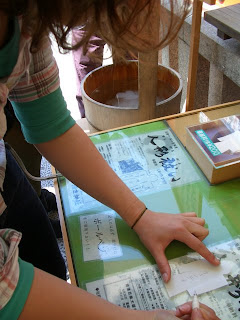
 The characters don't look that hard, but...
 Mmmmmm. Lunch time!! Okonomiyaki (egg pancake with cabbage and pork,) Hiroshima style with noodles inside. Delicious!
 Welcome to "Be-ri--Ha-u-su!"
 Enjoying the fruits of our (very marginal) labor.


 ...and looking down from the inside.
 Snack Time!!! ソフトークリム for me, and chocolate covered
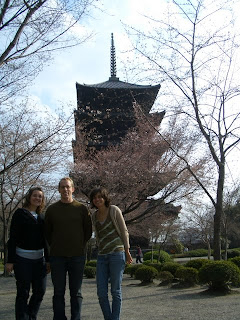

 They go on and on!!
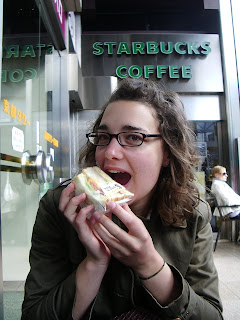 The four-bite sandwich I ate for breakfast.
 The
The 

 Watching them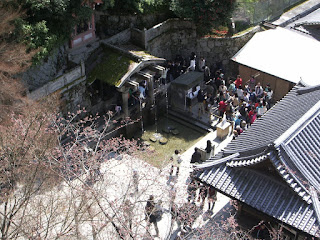


 A picturesque
 With the sun setting on our time in Kyoto, Kim and I returned to the station, got our bags from the locker and after spending about 20 minutes walking around in circles in the underground shopping area, found some suitable souvenirs and some dinner. We got on the train, relieved to be off our feet. Yes, I am getting old.


